Monday, January 11, 2021

BIOREMEDIATION AND BENEFICIAL MICROBES IN AQUACULTURE | Prasenjit Barman and Partha Bandyopadhyay #

1Research & Development Division, FINRAY BIOTECH INC., Mahavir Estate, Opp.

RDC Plant, Santej- 380060, Gandhinagar, Gujarat.

#FINRAY BIOTECH INC., Kolkata, West Bengal – 700078, INDIA.

#Corresponding Author:Partha Bandyopadhyay, Email: finraybiotech@gmail.com


Introduction

Aquaculture not only contributes to the world’s seafood demand but also plays a pivotal role in the national economy and poverty reduction plans of many countries around the world. In aquaculture, Shrimp (or prawn) farming is widespread throughout the tropical world. Presently, White leg shrimp, Penaeus vannamei, is the most widely cultured species across the world. However, this industry is beset by disease, mostly due to bacteria (especially the luminous Vibrio harveyi) and viruses. The high density of animals in hatchery tanks and ponds, with high inputs of protein-rich feed especially in intensive culture systems is conducive for bacterial growth and for the spread of pathogens. At a time when capture fisheries is levelling off, aquaculture production continues to increase. 


The increase in production is greatest in developing countries where, about 93 percent of aquaculture production originates. Aquaculture was once considered an environmentally sound practice because of polyculture practices and integrated systems of farming, which ensured optimum utilization of farm resources, including farm wastes. Presently, increased fish production is being achieved by the expansion of land and water under culture and the use of more intensive and modern farming technologies that involve higher usage of inputs such as water, feed, fertilizer and chemicals. As a result, aquaculture is now considered as a potential polluter of the aquatic environment and a cause of degradation of wetland areas. Aquaculture generates considerable amount of wastes, consisting of metabolic by-products, residual food, fecal matter and residues of prophylactic and therapeutic inputs, leading to the deterioration of water quality and disease outbreaks. Bioremediation - the application of microbes/enzymes to the ponds, is the method currently in use for improving water quality and maintaining the health and stability of aquaculture systems. Bioremediation involves mineralization of organic matter to carbon dioxide, maximizing primary productivity that stimulate shrimp production; nitrification and denitrification to eliminate excess nitrogen from ponds and maintaining diverse and stable pond community, where the pathogens are excluded from the system and desirable species get established. Apart from organic matter degrading (detritivorous)heterotrophic bacteria, nitrifying, denitrifying and photosynthetic bacteria are also generally employed in bioremediation. The major impact on the receiving water bodies are eutrophication, silting, oxygen depletion and toxicity of ammonia and sulfide. High organic load increases the oxygen demand in water bodies. This eventually reduces dissolved oxygen levels in aquaculture systems. The urine and faeces from the aquatic animals can cause high content of ammonia nitrogen and an increase of BOD. Ammonia is the main nitrogenous waste that is produced by fish via metabolism and is excreted through the gills.


Waste production in aquaculture

The physical, chemical and biological conditions of the culture environment have an influence on the health and productivity of shrimp. Exposure of shrimps to toxins like hydrogen sulphide, ammonia and carbon dioxide lead to stress and ultimately to disease. The types of wastes produced in aquaculture farms are basically similar. However, there are differences in quality and quantity of components depending on the species cultured and the culture practices adopted. The wastes in hatcheries or aquaculture farms can be categorized as: residual food and fecal matter, metabolic by-products,residues of biocides and biostats, fertilizer derived wastes, wastes produced during molting and collapsing algal blooms. 

Organic detritus & bioremediation 

The dissolved and suspended organic matter contains mainly carbon chains and is abundantly available to microbes and algae. A good bioremediation must contain microbes that are capable of effectively clearing carbonaceous wastes from water. Further it would be very supportive, when these microbes multiply rapidly and have good enzymatic capability. Members of the genus Bacillus like Bacillus subtilis, B. licheniformis, B. cereus, B. coagulans and species Phenibacillus polymyxa are good examples of bacteria suitable for bioremediation of organic detritus. However, they are not normally present in required quantities in the water column, their natural habitat being the sediment. When certain Bacillus strains are added to the water in sufficient quantities, they can make an impact. They compete with the bacterial flora naturally present for the available organic matter, like leached or excess feed and shrimp faeces. As a part of bio-augmentation, the Bacillus can be produced, mixed with sand or clay and broadcasted to be deposited in the pond bottom. Lactobacillus is also used along with Bacillus to break down the organic detritus. These bacteria produce a variety of enzymes that break down proteins and starch to small molecules, which are then taken up as energy sources by other organisms. The removal of large organic compounds reduces water turbidity.

Nitrogenous compounds & bioremediation

Nitrogen applications in excess of pond assimilatory capacity can lead to deterioration of water quality through the accumulation of nitrogenous compounds (ammonia and nitrite), causing toxicity to fish and shrimp. The principal sources of ammonia are excretion and sediment flux derived from the mineralization of organic matter and molecular diffusion from reduced sediment. Bacteriological nitrification is the most practical method for the removal of ammonia from closed aquaculture systems and it is commonly achieved by the setting of sand and gravel bio-filters through which water is allowed to circulate. The ammonia oxidizers are placed under five genera Nitrosomonas, Nitrosovibrio, Nitrosococcus, Nitrolobus and Nitrospira. Nitrification not only produces nitrate but also alters pH towards the acidic range, facilitating the availability of soluble materials. The vast majority of aquaculture ponds accumulate nitrate, as they do not contain a denitrifying filter. Denitrifying filters help to convert nitrate to nitrogen. It creates an anaerobic region where anaerobic bacteria can grow and reduce nitrate to nitrogen gas. Nitrate may follow several biochemical pathways, following production by nitrification.

Phosphorous & bioremediation

Phosphorus normally has limitations in a freshwater environment. Any deviation from the normal NO3/PO4 ratio is believed to be dependent on, which influences the rate of nitrification or bacterial regeneration of phosphorous, available in organisms mainly as phospholipids and nucleoproteins. Phosphorous is generated from organic compound as PO4 by certain bacteria that produce enzymes such as phosphatases and phytases. The solubility of inorganic phosphatases is primarily a function of pH. Bacteria are capable of liberating PO4 from these compounds through the production of organic and mineral acids.

Hydrogen sulphide (H2S) & bioremediation

Sulphur is of some interest in aquaculture because of its importance in anoxic sediments. In aerobic conditions, organic sulphur decomposes to sulphide, which in turn gets oxidized to sulfate. Sulfate is highly soluble in water and so gradually disperses from sediments. Sulphide oxidation is mediated by micro organisms in the sediment, though it can occur by purely chemical processes. Organic loading canstimulate H2S production and reduction in the diversity of benthic fauna. Hydrogen Sulphide is soluble in water and has been suggested as the cause of gill damage and other ailments in fish. Unionized H2S is extremely toxic to fish that may occur in natural waters as well as in aquaculture farms. Bioassays of several species of fish suggest that any detectable concentration of H2S should be considered detrimental to fish production. Photosynthetic benthic bacteria that break H2S at pond bottom have been widely used in aquaculture to maintain a favorable environment. These bacteria contain bacterio-chlorophyll, that absorb light and perform photosynthesis under anaerobic conditions. They are purple and green sulphur bacteria that grow at the anaerobic portion of the sediment - water interface. Photosynthetic purple non-sulphur bacteria can decompose organic matter, H2S, NO2 and harmful wastes of ponds. The green and purple sulphur bacteria split H2S to utilize the wavelength of light not absorbed by the overlying phytoplankton. The purple and green sulphur bacteria obtain reducing electrons from H2S at a lower energy cost than H2O splitting photoautotrophs and thus require lower light intensities for carrying out photosynthesis. Chromatiaceae and Chlorobiaceae are the two families of photosynthetic sulphur bacteria that favour anaerobic conditions for growth while utilizing solar energy and sulphide. Chromatiaceae contain sulphur particles in cells but Chlorobiaceae precipitate them out. The family Rhodospirillaceae is not of any use for H2S removal, but can be used as efficient mineralizers at pond bottom, as they grow in both aerobic and anaerobic conditions as heterotrophic bacteria, even in the dark without utilizing solar energy. The common examples of photosynthetic bacteria of importance in aquaculture are Rhodospirillum, Rhodopseudomonas, Chromatium, Thiocystis, Thiospirillum, Thiocapsa, Lamprocystis, Thiodictyon, Thiopedia, Amoebobacter, Chlorobium, Prosthecochloris,Pelodictyon and Clathrochloris. For bioremediation of H2S toxicity, the bacterium that belongs to Chromatiaceae and Chlorobiaceae can be mass cultured and can be applied as pond probiotic. Being autotrophic and photosynthetic, mass culture is less expensive and the cultured organisms can be adsorbed on to the sand grains and applied, so that they may reach the pond bottom to enrich the hypolimnion and ameliorate H2S toxicity.

Conventional approaches for addressing challenges in aquaculture

The rearing of fish in reticulated systems results in a highly artificial environment which has a propensityfor the accumulation of waste metabolites andwhich promotes the growth of pathogenic bacteria. Management considerations for aquaculture operations include nutrition, water quality, physical parameters as well as pathogen and disease control. A wide range of chemicals such as topical disinfectants, organophosphates, antimicrobials and parasiticides are often used to deal with disease and water quality. Water quality is traditionally managed through conventional filtration systems, which are sensitive to process fluctuations and can result in mass mortality when the systems crash.


Conventional biofiltration

Normally the oxidation of ammonia to the morebenign nitrate ion occurs through ammonia and nitrite oxidizing obligate chemoautotroph such as Nitrosomonas and Nitrobacter spp. These are slow growing and sensitive to fluctuations in environmental conditions. Removal of nitrate and nitrite is a challenge in intensive aquaculture operations. System fluctuations, resulting from the sensitivity of natural filter bacteria, often lead to accumulation of ammonia, nitrite, nitrate and phosphate. Although the concentration of these residues can be reduced by the addition of fresh water, purges of effluent containing high concentrations of these compounds into natural river and seawaters, results in a deterioration of the environment and can lead to algal blooms, which may be detrimental to natural ecosystems. High capital investment is thus required for installation of larger scale filtration systems to compensate for the seinefficiencies of conventional filtration. At present heterotrophic nitrifying and aerobic denitrifying bacteria are frequently used in aquaculture for the removal of toxic nitrogenous pollutant which removes ammonia, nitrate and nitrite faster than chemoautotrophs. Heterotrophic organisms work properly in aerobic condition, which is a very essential parameter for the sustainable shrimp culture.


Biological solutions as alternatives for addressing challenges in aquaculture

Given the challenges in conventional aquaculture practices, alternative methods for disease control and enhancement of water quality are desperately required. Micro-organisms play important roles in aquaculture, particularly with respect to nutrient cycling and the nutrition of the cultured animals, water quality, disease control and the environmental impact of effluent. Beneficial microbes can be used to alter or regulate the composition of bacterial flora in a water system to optimize fish production by reducing pathogen concentration, by improving water quality through reduction of waste ions and through accelerated mineralization and nitrification, by reducing algal growth and by accelerating sediment decomposition. These biological agents also confer the added advantage of natural integration into existing ecosystems and present opportunities for development of multi-effect products which are attractive to endusers. The marketing of biological and “organic certified” solutions for enhancement of fish health has also gained consumer acceptance. The use of beneficial microbes is a more appropriate remedy than the use of chemicals, but successful application requires an understanding of the ecological processes occurring in aquaculture systems, of the agents responsible for disease and knowledge of the beneficial characteristics of bacteria to be used as biological agents.

Biological agents

Microbial webs are an integral part of all aquaculture systems and have a direct impact on productivity, especially in intensive culture operations. The quality of water and health of the cultured species is governed by the activities of a diversity of microbes with different roles and interactions in the ecosystem. There are distinct uses of bacterial supplements in


aquaculture for bio-augmentation as probiotics as well as biocontrol and bioremediation agents. Bio-augmentation refers to the augmentation of the environment with microbes to result in enhanced fish health, while probiotics are normally associated with feed and digestion. A strict definition of biocontrol agents is that they are microorganisms that are antagonistic to pathogens. In some instances,however the description of biocontrol agents transcends the boundary between bio-augmentation, and the exclusion of pathogens. Bioremediation refers to the breakdown of pollutants or waste by microbes.Probiotics can be defined as a cultured product or live microbial feed supplement, which beneficially affects the host by improving its intestinal balance (Fig. 1). The important components of this definition reflect the need for a living microorganism and application to the host as a feed supplement. A broader definition is that of a live microbial supplement, which beneficially affects the host animal by improving its microbial balance. In a third proposed definition, a probiotic is any microbial preparation, or the components of microbial cells, with a beneficial effect on the health of the host. It is thus apparent that there are variations in the actual application of the terminology associated with biological agents. Based on the observation that organisms are capable of temporarily modifying the bacterial composition of water and sediment, it was suggested that the definition should include the addition of live naturally occurring bacteria to tanks and ponds. Given the broad-spectrum effects of microbial consortia used in aquaculture, some scientists described a biological agent as a live microbial adjunct, which has a beneficial effect on the host by modifying the host-associated or ambient microbial community, by ensuring improved use of the feed and enhancing its nutritional value, by enhancing the host response towards disease, or by improving the quality of its ambient environment. The range of biological treatments examined for use in aquaculture has encompassed both Gram-negative and Gram-positive bacteria, bacteriophages, yeasts, unicellular algae, enzyme preparations and plant extracts. Microbes have been successfully applied to aquaculture systems via inclusion in artificial or live feed, by addition to bio-filtration systems and by direct addition to water. Most biological treatments used in aquaculture belong to the genera Lactobacillus, Vibrio, Bacillus, or Pseudomonas, although other genera have been applied to a lesser extent.

Probiotics: An essential tool in intensive shrimp aquaculture

As aquaculture develops, the industry faces several  challenges related to its environmental impact. The

application of beneficial bacteria (probiotics) is not only associated with gut health (feed probiotics), but also with bioremediation that improves the environment (water and soil) in which the animals are reared (Table. 1). A key factor for successful aquaculture is to understand the interactions between the microbial environment, gut flora and immune system of the shrimp, as well as factors that determine the persistence of microbial species in the internal and external microbial ecosystems. While natural ecosystems are balanced, the farming environment favours the growth of microorganisms as it is rich in nutrients and feed waste.

Conclusion

The traditional practice of extensive land-based aquaculture is under pressure, due to limitations in available space and environmental considerations. This has led to the increased use of more intensive reticulated systems which also offer the benefit of greater control of physiological culture conditions. While intensive systems offer the advantages of increased stocking densities and higher production throughput, challenges include water quality and increased disease prevalence among others. These are driving the adoption of environment friendly solutions, that meet consumer expectations and comply with regulatory requirements. Beneficial microbes provide an attractive option. Issues that require attention to accelerate the adoption of biological solutions include elucidation of the mode of action of commercially beneficial microbes and demonstration of clear costbenefit advantages for commercial products. Readers may kindly contact the authors for references

Monday, July 15, 2019

Effect of a probiotic bacterium Bacillus circulans PB7 in the formulated diets: on growth, nutritional quality and immunity of Catla catla (Ham.)

Partha Bandyopadhyay Æ Pradeep K. Das Mohapatra


Abstract Bacillus circulans PB7, isolated from the intestine of Catla catla, was evaluated for use as a
probiotic supplement in the feeds for the fingerlings of Catla catla. The effect of supplement on the growth performance, feed utilization efficiency, and immune response was evaluated. Catla fingerlings (ave. wt. 6.48 ± 0.43 g) were fed diets supplemented with 2 9 104 (feed C1), 2 9 105 (feed C2), and 2 9 106 (feed C3) B. circulans PB 7 cells per 100 g feed for 60 days at 5% of the body weight per day in two equal instalments in triplicate treatments. The control feed
(CC) was not supplemented with the B. circulans. All the feeds were isocaloric and isonitrogenous. Fish fed with feed C2 displayed better growth, significantly (P B 0.05) highest RNA/DNA ratio, a lower feed conversion ratio (FCR), and a higher protein efficiency ratio (PER) than the other experimental diets. Highest carcass protein and lipid was also observed in the fish fed C2 feed compared to the others. Significantly (P B 0.05), highest protease was recorded in fish fed feed C2 (47.9 ± 0.016) and lowest in fish fed feed C3 (32.10 ± 0.009), where a-amylase activity did not
differ significantly (P B 0.05) beyond the lowest inclusion level. ALP, ACP, GOT, and GPT in the liver of Catla catla were the highest (P B 0.05) in fish fedC2 feed. The highest TSP, albumin, and globulin was observed in fish treated with C2 feed after 60 days feeding trial, but the lowest glucose level was observed in the same treatment. After the feeding trial, the nonspecific immunity levels and disease resistance of fish were also studied. Phagocytic ratio, phagocytic index, and leucocrit value were the highest in fish fed feed C2. After the feeding trial, the fish were challenged for 10 days by bath exposure to Aeromonas hydrophila (AH1) (105c.f.u. ml-1 for 1 h, and, after 7 days, 107c.f.u. ml-1 for 1 h). Highest survival percentage was observed in fish fed with feed C2 compared with only 6.66% in the controls, which indicated the effectiveness of B. circulans PB 7 in reducing disease
caused by A. hydrophila. 

Keywords Bacillus circulans Probiotics Catla catla

Introduction

As a negative aspect of the success of aquaculture, increased intensification has led to higher outbreaks of disease, encompassing an ever-increasing range of pathogens (Austin and Austin 1999). To combat these diseases, the widespread use of broad-spectrum chemotherapeutants has led to drug resistance problems in aquaculture (e.g., Brown 1989; Karunasagar et al. 1994). In order to rectify this situation, greater emphasis has been placed on improved husbandry through better nutrition, improved water quality, and lower stocking densities, and the use of vaccines and non-specific immunostimulants, such as b-1,3 glucans (Austin and Austin 1999). Recently, attention has focused on the use of probiotics, using methods developed for human medicine and agriculture for which the mechanisms by which probiotics operate have been well defined (e.g., Fuller 1987, 1992; Smoragiewicz et al. 1993; Chang and Liu 2002; Bairagi et al. 2004; Alcaide et al. 2005; Akinbowale et al. 2006; Das et al. 2006; Wang 2007). Most probiotics are supplied as live supplements in food, which must have the ability to survive passage through the intestinal tract (Fuller 1992). The benefit to the host may arise as a nutritional effect, whereby the bacteria are able to breakdown toxic or otherwise innutritious components of the diet, which the host can then digest (Smoragiewicz et al. 1993). Alternatively, the probiotic may prevent potential pathogens from colonizing the gut by production of antimicrobial compounds, or by outcompeting them for nutrients or mucosal space (Smoragiewicz et al. 1993). Some studies have addressed the use of probiotics in aquaculture. In particular, improvements have been shown in the culture of larval Pacific oysters (Douillet and Langdon 1994) and turbot (Gatesoupe 1991) following use of bacterial isolates. Widespread use of probiotics has occurred in the Ecuadorian shrimp industry, where encouraging results have been obtained with batch cultures of Vibrio alginolyticus when applied to larval rearing tanks. Here, there was improvement in growth of Penaeus vannamei larvae, and a reduction in the incidence and severity of disease (Garriques and Arevalo 1995). This led to a reduction in the use of antibiotics during larval rearing (Garriques and Arevalo 1995). Subsequently, a probiotic isolate of V. alginolyticus was demonstrated to be effective in controlling infections in salmonids, as caused by Aeromonas salmonicida, Vibrio anguillarum, and Vibrio ordalii (Austin et al. 1995). However, the use of V. alginolyticus as a probiotic is of concern insofar as the taxon is also associated with disease (Alfaro et al. 1993; Austin and Austin 1993; Sutton and Garrick 1993; Lee et al. 1996; Balebona et al. 1998). From agriculture, it is apparent that the majority of probiotics comprise lactic acid bacteria notably Lactobacillus sp., Bifidobacterium sp., and Streptococcus sp. (Smoragiewicz et al. 1993). Lactic acid bacteria also form a major component of the normal microflora in the gastrointestinal tract of healthy fish (Ringo and Gatesoupe 1998). Consequently, the potential to use lactic acid bacteria as probiotics in fish has been examined. For example, lactic acid bacteria have provided turbot with protection against disease caused by Vibrio sp. (Gatesoupe 1994; Olsson et al. 1998). It has also been proved that LAB was able to protect Penaeus indicus against disease caused by Vibrio alginolyticus (Ajitha et al. 2004). Kennedy et al. (1998) used Bacillus 48 to enhance the quality and viability of common snook, Centropomus undecimalis, and found that Bacillus improved the survival of larvae, increased food absorption by enhancing protease level, and gave better growth, and also decreased the number of suspected pathogenic bacteria in the gut. In this study, a potential probiotic bacterium, Bacillus circulans PB 7 (determined by degree of antagonism) was incorporated in the feeds of Catla catla (Ham.), to determine the growth, nutritional quality, immunity, and survival against fish pathogenic Aeromonas hydrophila and the histopathological effects after a challenge trial.

Materials and methods

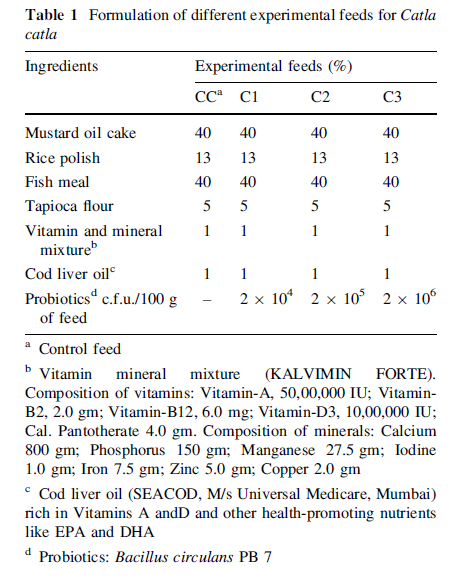
The present study was conducted at the Aquaculture Research Unit, Department of Zoology, Vidyasagar University, Midnapore (22 250 N, 87 200 E), and West Bengal, India. Catla (Catla catla) obtained from a carp culture farm at the vicinity of Midnapore town had an initial body weight of 6.43 ± 0.036 g. After acclimatizing for 15 days to prevailing laboratory conditions of water temperature (25–29 C) and pH (7.2–7.8), fish (6.48 ± 0.043 g) were released into continuous flow aquariums (76 9 41 9 41 cm3; 200 l capacity). Studies were conducted at room temperature for 60 days during June–August 2002. 468 Fish Physiol Biochem (2009) 35:467–478 123 Preparation of experimental feeds Different ingredients viz. oilcake, rice polish, and fish meal were used for preparing experimental feeds for Catla catla. The crude protein percentage of mustard oilcake, rice polish, and fish meal was 39.23, 13.03, and 48.65, respectively, whereas the crude lipid percentage was 11.24, 05.14, and 06.72, respectively. The four prepared feeds (CC, C1, C2, and C3) were formulated using locally available ingredients as shown in Table 1. Feed formulation was done basically by ‘‘square-method’’ using determined values of protein content of the ingredients (Table 1). The proportion of each ingredient required was calculated precisely providing allowance for the
premix. Dough was prepared and the feeds were pelleted separately with a locally made (Kolkata,
India) hand pelletiser for preparation of one kg feed. The pellets were dried in a thermostatic oven (M/s Modern Industrial, Mumbai, India) at 37 C to less than 10% moisture (Bazaz and Keshavanath 1993; Keshavanath and Renuka 1998) and stored in airtight jars at room temperature. Proximate compositions of


the four prepared feeds (CC, C1, C2, and C3) are detailed in Table 2. The probiotic bacterium Bacillus circulans PB 7 isolated from the intestine of Catla catla was grown in 48 h at 30 C in shaken bottles with nutrient agar medium (Hi-media, India). The cultures were centrifuged at 5,000g at 15 min in 4 C, washed thrice with sterile 1.0% NaCl solution, and the pellets resuspended in sterile saline water. The experimental diets were prepared by absorbing suspension of the probiotic bacteria. The prepared feeds were sterilized and spread in the sterile trays, and the absorption was achieved by spraying the suspended probiotic bacteria in 2 9 104 (C1), 2 9 105 (C2), and 2 9 106 (C3) B. circulans cells per 100 g feed. After spraying, the feed was air dried in a vent hood at room temperature overnight, and the moisture content and the bacterial concentration in the feeds (c.f.u. 100 g-1) was calculated. The bacterial concentration was calculated 1.86 9 104, 1.73 9 105, and 1.66 9 106 c.f.u. 100 g-1 of feed C1, C2, and C3, respectively. The control feed (CC) was not supplemented with the B. circulans. Finally, the feed was stored in vacuumed heavy-duty plastic containers at 4 C (Robertson et al. 2000). Routine checking of the bacterial concentration in the feeds did not show any marked variation. Studies on growth and dietary performances The experimental setup consisted of 15 rectangular aquarium (triplicates of each treatment) of 200 l
capacity with continuous aeration. Each aquarium was stoked with 15 fish. Water quality (temperature, pH, dissolved oxygen, total alkalinity, total NH3) was monitored at weekly intervals following the methods provided in APHA-AWWA-WPCF (1998). Fish were fed twice daily at 0800 and 1600 hours at 5% body weight (Swain et al. 1996) in two equal installments. The unutilized/leftover feeds orts were siphoned out 1 h after dispensing the feed into the aquarium. Fifty
percent of the water was replenished daily with aged water. The net weight was recorded every 15 days with an electronic balance (Adair Dutt Instruments, Kolkata, India) and feed quality was readjusted after every weighing period of 15 days. For evaluating the dietary performances, the nutritional indices like live weight gain (LWG), average daily growth (ADG), feed conversion ratio (FCR), specific growth rate (SGR), and protein efficiency ration (PER) were used. Two fish of each group were terminated through overdose anesthetization by MS222 (Sigma Chemicals, India) at the end of the experiment, and stored at -20 C until analysis. Proximate analysis Proximate analyses of ingredients, feeds, faecal matter, and body carcass were determined following the method provided in AOAC (1990). Moisture content was determined by drying the samples in hot air oven (M/s Modern Industrial) at 110 C for 24 h. Crude protein content (Total Kjeldahl Nitrogen 9 6.25) were
estimated by micro-Kjeldahl method. Crude lipid contents were determined by the soxhlet extraction
method using petroleum ether (boiling point: 40–60 C) in the electro-thermal Soxhlet apparatus. After extraction of lipid, the defattend samples were used for the estimation of crude fiber following Patra (2002). Ash content was estimated by incinerating samples in a muffle furnace at 500 ± 50 C for 10 h. One hour after feeding, the leftover feed was initially siphoned out and an equal amount of water replenished. For fecal matter analyses, pooled fecal matter was collected into Petri dishes from the bottom of the aquarium every 2 h by the help of a pipette (Singh 1989). The collected material was stored at -20 C (Sundaryono et al. 1996). The collected material was dried in an oven (M/s Modern Industrial) at 110 C for 24 h. Crude protein content (Total Kjeldahl Nitrogen 9 6.25) were
estimated by micro-Kjeldahl method. Crude lipid contents were determined by the soxhlet extraction
method using petroleum ether (boiling point: 40–60 C) in the electro-thermal Soxhlet apparatus. After extraction of lipid, the defattend samples were used for the estimation of crude fiber following Patra (2002). Ash content was estimated by incinerating samples in a muffle furnace at 500 ± 50 C for 10 h. One hour after feeding, the leftover feed was initially siphoned out and an equal amount of water replenished. For fecal matter analyses, pooled fecal matter was collected into Petri dishes from the bottom of the aquarium every 2 h by the help of a pipette (Singh 1989). The collected material was stored at -20 C (Sundaryono et al. 1996). The collected material was dried in an oven (M/s Modern Industrial) at 55 C, ground and preserved in airtight containers.

Biochemical analyses

DNA (deoxy-ribo nucleic acid) and RNA (ribonucleic acid) contents in 200 mg of liver (hepatopancreas) tissues were estimated as per the scheme given by Munro and Fleck (1969). The activity of the two digestive enzymes, protease and a-amylase, in the intestine of the fish were determined according to the method of Bernfeld (1955) as modified by Snell and Snell (1971). The GOT and GPT activity in the liver were determined following the method of Bernfeld (1955), while ACP activity was determined the method of Bramley (1974) and ALP activity by Rosauki (1993).

Determination of immunity levels

On day 60, blood was collected from fish of each group. Part of the blood was heparinized and the rest was allowed to clot for serum samples, which were preserved at -20 C for further analysis. Immediately after collection, the heparinized blood samples of each group were pooled to three aliquots. Part of the blood was analyzed for leucocrit value in duplicate per sample (Blaxhall and Daisley 1973). The rest of the heparinized blood was immediately used for the phagocytic assay (Siwicki et al. 1994; Park and Jeong 1996).

Challenge trial

After feeding for 60 days, the fish in each treatment were challenged with Aeromonas hydrophila AH1, which had been cultured and maintained in the Aeromonas selective medium (M884, Hi-Media). Fish in all replicates were immersed in a suspension of Aeromonas hydrophila AH1, *105 c.f.u. ml-1 according to Austin et al. (1995). This was followed by a second immersion *107 c.f.u. ml-1 after 7 days (Austin et al. 1995).

Statistical analysis

As all the above analyses were carried out on pooled samples of a given lot, standard errors or standard deviation of means were calculated. However, for evaluating the dietary performances, nutritional indices, enzymatic activities, and RNA:DNA ratio, immunological parameters, and challenge trials, significant differences between the means of the treatments were tested by Duncan Multiple Range Test (Duncan 1955) through SAS (1991).


Results

All the four experimental feeds (CC, C1, C2, and C3 in Table 1) were almost isocaloric and isonitrogenous. The average crude protein percentage on dry matter basis was around 36.92 and the gross energy was around 17.08 kJ g-1 (Table 2). The growth of Catla catla in relation to various
feeds was presented in Fig. 1. Significantly (P B 0.05) highest growth (20.15 ± 0.075 g) was obtained from fish fed feed C2, whereas lowest (16.95 ± 0.120 g) occurred in fish fed feed C3, which was even lower than the control (feed CC). Fish fed feed C2 showed significantly (P B 0.05) highest live weight gain (14.00 ± 0.086 g) followed by C1, CC, and C3 (Table 3). Significantly (P B 0.05) lowest FCR (2.26 ± 0.021) was obtained


from fish fed feed C2 while the highest (3.30 ± 0.042) was recorded in case of fish fed feed C3 (Table 3). It was also observed that significantly (P B 0.05) highest SGR of 1.98 ± 0.011 was obtained in the fish fed feed C2 showing better utilization of nutrients and the lowest (1.55 ± 0.014) in fish fed feed C3 showing lowest utilization of nutrients. Similarly, the highest (P B 0.05) PER of 1.22 ± 0.010 was obtained in fish fed feed C2, which indicated better utilization of protein for growth and metabolism (Table 3). Initial and final carcass composition of Catla catla in relation to various feeds was presented in Table 4. The carcass composition of the fish revealed an apparent increase in the final carcass protein and lipid (P B 0.05) over the initial carcass protein and lipid. Significantly (P B 0.05) highest carcass protein (65.48 ± 0.002%) and lipid (22.80 ± 0.004%) was recorded in fish fed feed C2, while the lowest was in the controls (CC). These results indicated that enhancement of carcass quality by probiotic-supplemented (Bacillus circulans PB 7) feeds may be due to enzymatic activity in the gut and thereby better nutrient utilization. Proximate composition of fecal matter of Catla catla during the 60-day feeding trial is presented in Table 5. Fecal matter proximate analysis revealed significantly (P B 0.05) greatest nitrogen excretion (14.86 ± 0.006%) in fish fed feed CC and least (11.52 ± 0.007%) in fish fed feed C2 (Table 5). The crude lipid remained between 02.19 ± 0.001% (feed C1) and 3.16 ± 0.002% (feed CC). The relationships of different water quality parameters did not follow any specific trend of controlled conditions and isocaloric feeds. The water quality during the study, period remained in the following


ranges: pH, 7.47 ± 0.182–7.52 ± 0.164; total alkalinity 130.80 ± 4.980–140.25 ± 9.680; DO, 4.40 ±
0.595–5.63 ± 0.420; total ammonia, 0.270 ± 0.031– 0.390 ± 0.028, and average temperature was
30.00 ± 1.155. Significantly (P B 0.05) greater RNA:DNA ratio (1.95 ± 0.011) was registered in fish fed feed C2 and least (1.66 ± 0.010) in fish fed feed CC (Fig. 2). It was also observed that the RNA:DNA ratio of fish increased in all the treatments over the initial RNA:DNA ratio. Significantly (P B 0.05) highest protease was recorded in fish fed feed C2 (47.9 ± 0.016) and lowest in fish fed feed C3 (32.10 ± 0.009) (Table 6), whereas there were no significant differences (P B 0.05) in a amylase activity (Table 7). The ACP activity in the liver was greatest (P B 0.05) in case of fish fed feed C2 (3.78 ± 0.027) and least (2.06 ± 0.032) in case of fish fed feed CC (Table 8). Similarly, ALP activity in the liver was shown a similar trend (Table 8).


Significantly (P B 0.05) highest GOT (0.052 ± 0.000) and GPT (0.083 ± 0.002) values were registered in fish fed feed C2, whereas lowest (0.045 ± 0.000) GOT value was recorded in fish fed feed CC and GPT value (0.044 ± 0.005) in fish fed feed C3 (Table 8).


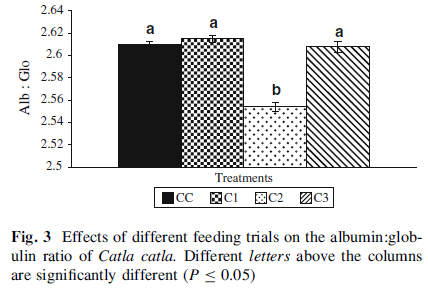
The effect of different feed treatments on the albumin:globulin ratio is presented in Fig. 3. Highest
albumin:globulin ratio was recorded in fish fed feed CC and lowest in fish fed feed C2. The albumin:globulin ratio showed a similar trend after challenge trial, but the values were slightly lower than the feeding trial, perhaps because of decrease in TSP values. The effect of probiotics (Bacillus circulans PB 7) on non-specific immunity was observed. Significantly (P B 0.05) highest phagocytic ratio (63.00 ± 1.22), phagocytic index (2.34 ± 0.09), and leucocrit value (62.20 ± 1.80) were recorded in fish fed feed C2, whereas the lowest of all the values (8.00 ± .086, 1.49 ± 0.20, and 34.10 ± 3.86, respectively, were recorded in fish fed feed C3 (Figs. 4, 5, and 6, respectively). After a 10-day challenge trial, significantly (P B 0.05) highest survivability (96.66%) was


observed in fish fed feed C2, followed by fish fed C1 (53.33%), C3 (40%), and CC (6.66%) (Fig. 7).
Regression results of different parameters with respect to different probiotic supplements in Catla
catla are presented in Table 9.


Discussion 


Aerobic gram-positive endospore-forming bacteria, i.e., Bacillus sp., have been evaluated as probiotics, with uses including the improvement of water quality
by influencing the composition of water-born microbial populations and by reducing the number of
pathogens in the vicinity of the farmed species (Wang et al. 1999). Thus, the bacilli are thought to
antagonize potential pathogens in the aquatic environments. This is curious because it is generally
accepted that laboratory cultures do not survive well when re-introduced into the natural environment, the cells being often outcompeted/antagonized by the natural microflora (Austin et al. 1995). Nevertheless, direct benefits from the use of the bacilli were a reduction in the use of chemicals in the aquatic environment and enhanced growth of farmed species (Wang et al. 1999).
The use of probiotics has been accompanied by a concomitant reduction in the levels of antimicrobial
compounds (particularly antibiotics) used in aquaculture, and improved appetite and/or growth
performance of the farmed species. The former is obvious insofar as if the animals are otherwise
healthy then there will no need to use antimicrobial compounds. However, the inference about improved appetite and growth is more difficult to reconcile. In particular, it is important to determine whether or not probiotic actually tastes good or does it modify the feed thereby improving digestibility (and taste). Apart from laboratory preparations of bacteria, some workers have used commercially available products. For example, Queiroz and Boyd (1998)


and Moriarty (1998) used commercial preparations containing Bacillus sp. in catfish and shrimp ponds, respectively. Hirata et al. (1998) used mixed cultures consisting mainly of Bacillus sp. to improve the performance of the rotifer, Branchionus plicatilis, in water. Furthermore, Kennedy et al. (1998) used Bacillus 48 to enhance the quality and viability of common snook, Centropomus undecimalis (Bloch). These workers found that Bacillus improved the survival of larvae, increased food absorption by enhancing protease levels, and gave better growth. Also, the probiotic decreased the number of suspected pathogenic bacteria in the gut. It is noteworthy that Chang and Liu (2002) used Bacillus toyoi and Enterococcus faecium SF 68 from commercial products to reduce Edwardsiellosis in the European eel, Anguilla anguilla (L.). An extracellular proteaseproducing bacteria, Bacillus circulans (Lr 1.1), was isolated by Ghosh et al. (2003) from the gut of Labeo rohita fingerlings and used as supplement in the diets

and the effect of supplement on growth performance and utilization efficiency of L. rohita was measured. The diet containing 1.5 9 105 Bacillus circulans cells per 100 g showed significantly better growth, lower feed conversion ratio, higher protein efficiency ratio, and highest protease activity. Similar observations were also recorded in the present study, where 2 9 105 Bacillus circulans PB 7 cells per 100 g showed significantly better growth, lower feed conversion ratio, higher protein efficiency ratio, and highest protease activity. In this study, although all the feeds were isonitrogenous, the concentration of probiotics in the C2 feed might be helpful for proper nutrient utilization. The whole body carcass composition and lower nitrogen egestion which were observed in fish fed feed C2 is attributable to proper probiotic concentration, whereas reduced carcass composition and greater nitrogen egestion were observed in fish fed feed C3, which could have also been due to the overall low feed utilization level. RNA:DNA is known to provide a dependable indication of growth trend (Buckley 1980; Khan and Jafri 1991; Bandyopadhyay et al. 2005). The ratio was the greatest in the fish fed C2 feed with higher dietary utilization and best growth. Bazaz and Keshavanath (1993) found a higher RNA:DNA ratio in better growing fish fed with oil-supplemented diets using equal level of crude protein. The present study also reports such a finding where all the feeds were isocaloric and isonitrogenous, but 2 9 105 Bacillus circulans PB 7 cells per 100 g incorporated feed (feed C2) exhibited better growth as well as better RNA:DNA ratio. The highest levels of GOT and GPT were found with the feed C2 and the lowest in the control (feed CC),
which may be because of the better dietary protein utilization. Most of the amino acids normally found in protein undergo transamination reactions, and transaminases are localized in both cytosol and mitochondria (Wada and Marino 1964), which is induced by high protein diet (Swick et al. 1965). Thus, a positive correlation between the probiotic concentration and the GOT and GPT levels in the liver could be observed. The ALP and ACP activities of the liver also showed an excellent trend and were dependent upon the probiotic concentration in the feed. It was observed that the probiotic-containing feed C2 showed higher ALP and ACP activity as well as higher dietary utilization and growth, which was similar to the observation of Bandyopadhyay et al.
(2005). In this present study, a superior growth performance in terms of live weight gain and specific
growth rate was noted in C. catla fed feed C2 when compared to other treatments. This observation draws attention to an essential inference that the probiotic concentration, which was used in this feed, might be helpful for optimum dietary utilization. It was also observed that P/E ratio was highest in fish fed feed C2 although with the highest dietary utilization. Mohanty et al. (1996) reported that the higher the dietary utilization the higher the P/E ratio, which was contradicted in fish fed feed C2 in this study. This may be because of the supply of higher energy from the higher carcass lipid content in fish fed feed C2. The results obtained in this study not only support the use of probiotic (Bacillus circulans PB 7) for better growth and proper nutrient utilization but also confirm it to be an important immunostimulant in Catla catla. There was a statistically significant (P B 0.05) increase in all the parameters of non-specific immunity examined, as well as a higher survival against the pathogenic Aeromonas hydrophila infection, thus indicating it as a potent immunostimulant in Catla catla. Highest PR, PI, and leucocrit value (P B 0.05) and lowest albumin: globulin ratio (P B 0.05) were observed in fish fed feed C2 might be due to increased lymphocyte proliferation and subsequent immunoglobulin production. A similar observation was made by Sahoo and Mukherjee (2001) by using b-1,3, glucan as an immunostimulant. The findings of this study suggest that the concentration of probiotic Bacillus circulans PB 7 applied in feed C2 was able to increase the overall physiological performances and enhance the defense mechanism in the fingerlings of Catla catla. Further investigation should be applied by preparing the feeds with different concentrations of this probiotic bacterium between the two best feeds achieved in this study. The findings should also be confirmed in outdoor, earthen pond, trials before commercialization.

Friday, June 21, 2019

Impact of Cypermethrin and Carbofuran on the Ovarian Cycle of the Indian Major Carp, Labeo rohita (Hamilton)


Biplab Sarkar Arabinda Mahanty Ashis Saha Arttatrana Pal
Partha Bandyapadhyay Sampad Kumar Sarkar Subhendu Adhikari
S. Ayyappan
Received: 31 May 2013 / Revised: 14 September 2013 / Accepted: 23 October 2013 / Published online: 26 November 2013
_ The National Academy of Sciences, India 2013


Abstract A short term histological study was conducted
to determine the impacts of technical grade synthetic
pyrethroid insecticide, cypermethrin and carbamate pesticide,
carbofuran on different phases of ovarian maturation
of freshwater indigenous carp, Labeo rohita. Adult females
of L. rohita were exposed to sublethal doses of carbofuran
(0.06, 0.15 mg/L) and cypermethrin (0.16 and 0.40 lL/L)
for 4 weeks during the pre-spawning (March), spawning
(July) and post-spawning (November) phase. In the
spawning phase, the carp showed maximum ovarian damage
by both the pesticides while the pre-spawning phase
was the next impaired stage. Considering all the phases of
ovarian maturation, cypermethrin exhibited greater level of
impact than carbofuran in both of its doses. Gonadosomatic
indices for all these phases were also measured. In
the reproductive cycle of fish, reduction in gonado-somatic
index occurred by both the pesticides in all of its doses and
the order was spawning[pre-spawning[post-spawning.
It is concluded that ovarian maturation in Indian carp is
affected by both the pesticides.

Keywords : Carbofuran _ Cypermethrin _
Gonado-somatic index _ Histology _ Labeo rohita _
Ovary

Introduction
In recent years, insecticides are used extensively in agriculture
for the pest control but their residues often reach
aquatic ecosystems. As a result of the chemical contaminants,
many freshwater ecosystems are faced with spatially
or temporally alarming levels of these xenobiotic chemicals.
They are transferred through phytoplankton to fish and
ultimately to humans. Different synthetic pyrethroid pesticides
have largely displaced organophosphorous and organochlorine
pesticides in last two decades throughout the
world. Fish sensitivity to pyrethroids may be explained by
their relatively slow metabolism and elimination of these
compounds [1]. Although these are not persistent in the
environment, their acute toxicity to fish is high [2]. Among
different pyrethroids, cypermethrin is a synthetic pyrethroid
which is used to control many pests and is discharged into the
aquatic environment [3]. Several laboratory studies have
shown that cypermethrin is extremely toxic to fish and
aquatic invertebrates even at very low concentrations [4].
Fish is highly sensitive to very low concentration of cypermethrin
(0.4–2.2 lg/L) and acute exposure of cypermethrin

B. Sarkar
National Institute of Abiotic Stress Management, Baramati,
Pune, India
A. Mahanty
Central Inland Fisheries Research Institute, Barrackpore,
Kolkata, India
B. Sarkar _ A. Mahanty _ A. Pal
School of Biotechnology, KIIT University, Bhubaneswar, India
B. Sarkar (&) _ A. Saha _ S. K. Sarkar _ S. Adhikari _
S. Ayyappan
Central Institute of Freshwater Aquaculture, Kausalyaganga,
Bhubaneswar, India
e-mail: biplabsarkar.niam@gmail.com;
biplab_puru@yahoo.co.in
P. Bandyapadhyay
Aquaculture Research Unit, Vidyasagar University, Midnapore,
West Bengal, India
S. Ayyappan
Director General Office, Indian Council of Agriculture Research,
Krishi Bhavan, New Delhi, India

Proc. Natl. Acad. Sci., India, Sect. B Biol. Sci. (Oct–Dec 2014) 84(4):989–996
DOI 10.1007/s40011-013-0265-8

inhibits enzymatic activities, total protein, soluble protein
and structural protein contents in fish tissues [5]. Carbofuran
is an insecticide widely used in crops including rice, strawberries,
alfalfa, corn, grapes, soybeans, and wheat. Carbofuran
is a cholinesterase inhibitor. Owing to its relatively
short half-life in the environment, it is used as a substitute for
insecticides known to persist for long period of time and
accumulate in animal tissues [6]. Relatively high water solubility
of carbofuran coupled with its relatively low
adsorption on soils and sediments permits natural surface
waters to become a repository for excessive amounts of the
insecticide, escaping treated areas and being accidentally
introduced into aquatic environments. Carbofuran’s persistence
is directly related to the pH of the water. The toxicity,
metabolism, and degradation of carbofuran have been
extensively studied in aquaculture. Among freshwater
organisms, fish is the most sensitive and LC50 values for
carbofuran in different fish varieties range from 130 to
14,000 ppb in tests of 72–96 h [6].
Gonadal maturation is an important phenomenon in fish
physiology that ultimately triggers the reproductive success,
fertilization and hatching process leading to maximization
of fingerling number. This phase also determines
the success of professional aquaculture practices. Carps
contribute substantially to Indian aquaculture production.
Among carps, rohu is the major cultivable and marketable
fish in India. There are some reports on pesticide induced
toxicity in different fish but this is restricted to gonad of
perches, mullets, catfishes [711] and in model fish like
zebra, gold fish etc. or in fingerlings of carp but very few
reports are available on mature, Indian major carps like
rohu due to their tough and hardy maintenance in the large
polyfibre pool at wet lab system as the trials cannot be
conducted in aquarium due to their large size. In other way,
pesticide experiments cannot be conducted in open ponds.
The present attempt to evaluate the pesticide toxicity in
mature rohu will incorporate new database in environmental
toxicology and fishery.


Material and Methods
Fish Samples
Female L. rohita (average weight: 0.8–1 kg; average
length: 41 ± 2 cm and age over 1.5 years) were collected
from stocking pond of Central Institute of freshwater
aquaculture (CIFA), Bhubaneswar, India, at three different
time periods round the year (March— pre-spawning phase;
July—spawning phase; November— post spawning phase).
Fishes were transferred to a circular polyfibre pool (volume
2,500 L) after treatment with 0.1 % KMnO4 solution to
avoid any external infection and then acclimatized under
laboratory conditions for 18 days using aeration facility
and natural photoperiodic regime. Fish samples were fed
twice a day at 3 % body weight by CIFACA (protein—
30.80 %; fat—5 %; carbohydrate—40.50 %; energy—
3,600 kcal kg/L), a special feed supplement for carps
developed at the CIFA, Bhubaneswar, India.

Experimental Design
Acclimatized fishes were divided into five experimental
groups having six fish in each group. The 96 h LC50 was
determined for both the pesticides by static bioassay. Two
groups were treated with two different sublethal concentrations
of cypermethrin and another two groups were
treated with two different sublethal concentration of carbofuran.
1/10th and 1/4th of LC50 values for both the pesticides
were taken as sublethal doses (0.16 and 0.40 lL/L
for cypermethrin; 0.06, 0.15 mg/L for carbofuran). The
fifth group was kept as control. These doses were calculated
and selected according to the earlier results of LC50
value obtained from L. rohita by applying these two pesticides
and by considering their predictive permissible limit
in the aquatic environment as reported by EPA. Pesticides
were applied only at the beginning of experiment. Experiment
was continued for 28 days along with CIFACA feed
(3 % of body weight). Cypermethrin and carbofuran were
supplied on request by respective manufacturing companies
(Rallis India Limited and Hindustan Insecticides
Limited respectively) with proper certificate of analysis.
The concentrations of the pesticides in water were not
determined further as known amount of both the pesticides
were used in a definite quantity of water. Quality of the test
water was monitored every week as per the protocols of
APHA [12]. As experiments were conducted on brood fish
which required extensive experimental set up and maintenance,
replication of experiments were conducted for two
consecutive years. The results were taken as mean of the
two.

Histological Processing
At the end of the experimental period, weights of two fish
from all individual groups were measured. The selection of
two fish were done on the basis of comparatively higher
and lower size fish within the homogenous group of six fish
in each category. The fishes were then vivisected and
ovaries were carefully removed. Gonado-somatic Index
(GSI) for each fish was calculated as the weight of the

gonads relative to the total body weight expressed as percentage
using the formula:

GSI = weight of the ovary / weight of the fish *100

To calculate the significance level of this study, one way
ANOVA (Duncan multiple range test) were performed
[13]. Test of significance were examined at 5 % level.
Pieces of ovary from the anterior, middle and posterior
regions were pooled and fixed in aqueous Bouin’s fluid.
Paraffin sections were cut at 5–6 lm using a rotary
microtome (ERMA, Japan) and stained with Harris haematoxylin
and Eosin. Slides with best distinctive histological
features were selected for comparison through
detailed observations using a binocular compound microscope
(Zeiss axiophot, West Germany) and photomicrographs
were taken in an automatic photo micrographic
system.

Results and Discussion
Pre-Spawning Phase

Ovarian histology was observed after 28 days treatment
with two doses of carbofuran and cypermethrin along with
control animals. First dose (0.06 mg/L) of carbofuran
treatment showed little degeneration in ooplasm with no
other prominent change (Fig. 1a) where as deformity in
follicular structure such as degeneration of follicular wall,
ooplasm and connective tissue was recorded in second dose
(0.15 mg/L) of treatment (Fig. 1b). Similarly, first dose
(0.16 lL/L) of cypermethrin treatment showed low atresia
and no change in shape and structure of follicular wall
(Fig. 1c). Reduction in size and deformity of oocytes,
necrosis in ooplasm, disorganized nucleus and degeneration
of follicular wall was observed in second dose
(0.40 lL/L) of treatment (Fig. 1d). In ovarian histology of
control fishes, follicles were moderate. They contained
yolk droplets, nucleus and a large number of spherical
follicles (Fig. 1e).

Spawning Phase
First dose (0.06 mg/L) of carbofuran treatment showed
little atresia with thick ovarian wall; no other prominent
changes were observed (Fig. 2a). In second dose (0.15 mg/L)
of treatment, medium atresia, thick ovarian wall and
changes in shape of follicles were noticed (Fig. 2b). Similarly,
first dose (0.16 lL/L) of cypermethrin treatment
showed medium atresia of vitellogenic follicles and
reduction in size and deformity in follicles (Fig. 2c).
Intense atresia of vitellogenic degeneration of follicular
wall and ooplasm, clumped cytoplasm and mature ovaries
in a stage of regression were noticed in second dose
(0.40 lL/L) of treatment (Fig. 2d). As shown in Fig. 2e,
control ovaries occupied the entire body cavity. Ovarian
walls were very thin, almost transparent. Ovaries were
turgid with a large number of translucent eggs. Follicles
contained poorly defined nucleus with vacuolated cytoplasm
and yolk globules (Fig. 2e).

Post-Spawning Phase
First dose (0.06 mg/L) of carbofuran treatment showed
very little or no changes in ovarian wall except the
deformed follicles (Fig. 3a). In second dose (0.15 mg/L) of
treatment, small degeneration in ooplasm and deformed
follicles were noticed along with wide inter follicular space
(Fig. 3b). Similarly, first dose (0.16 lL/L) of cypermethrin
treatment showed little degeneration in ooplasm with no
other prominent changes (Fig. 3c) where as medium atresia,
increase in inter follicular space, degeneration of follicular
wall, ooplasm, and shrunk up follicles were
observed in second dose (0.40 lL/L) of treatment
(Fig. 3d). Ovaries of control fishes were flaccid, shrunken
and sac like with reduced vascular supply. Some unspawned
large follicles and many small follicles were noticed
with dark stained nucleus (Fig. 3e).

Gonado-Somatic Index
Dose effect of cypermethrin and carbofuran on GSI of L.
rohita is presented in Table 1 and 2 respectively. It is
evident from the results that the reduction of GSI was
maximum at spawning stage at both the doses for both the
pesticides in comparison to control. The reduction was also
more at higher dosages as compared to lower.

Water Quality
The physico-chemical character of the water was analyzed
over the study period i.e. water temperature 27–30 _C,
pH 7.8–8.3, dissolved oxygen 5–5.8 mL/L, hardness
80–110 mg/L as CaCO3, alkalinity 135–148 mg/L as
CaCO3, calcium 25–30 mg/L, ammonia nitrogen
0.02–0.05 mg/L.
A fundamental contribution of ‘green revolution’ has
been the development and application of insecticides for
the control of a wide variety of insectivorous and herbaceous
pests which would otherwise diminish the quantity
and quality of food production. Most of insecticides have


been known to be highly toxic to non-target organism like
fish that inhabit natural environment close to agricultural
field. The impact of insecticides or pesticides on fish
reproductive system has been documented in various fish
species.
It has been reported that histological features of the
teleost fish ovary vis-a`-vis maturation of oocytes are
adversely affected by different chemical biocides as
observed presently in L. rohita [1417]. Fishes exposed to
pesticides lead to lowered steroidogenesis [17], inhibition
of development of advanced oocytes and thus reducing the
number of viable oocytes [18] and fall in 32p uptake by
ovaries [19]. Moreover, reduction in GSI seems to be the
most important and common effect in female fish due to the
exposure to pesticides. Similar results have also been
observed in the present study [2023]. The increase in
follicular atresia was next most obvious influence of pesticides
on fish ovary. Both the pesticides inhibited growth
of oocytes and raised incidences of follicular atresia as
evident in the ovary of L. rohita exposed to carbofuran and
cypermethrin and in the case of some other fishes also [8].
Effect of pesticides on fish reproduction and their possible
mechanism of action has been reported by Kumar et al. [24].
Low dose of metacid-50 and carbaryl produced reproductive
damage in northern pike as a result of homeostatic imbalance
in gonadotropic hormone and gonadotropic releasing hormone
(GnRH) [25]. The lack of proper gonadotropic stimulation
also caused atresia in this species. From these different
studies, it has been accomplished that pesticides affect the
follicular growth causing follicular atresia in fish ovary by
inhibiting the secretion of gonadotropins from the pituitary
and affecting the metabolic activities of the liver as the
growth of vitellogenic follicles is closely related to synthesis
of yolk in the liver [3].
Vitellogenesis is a multistep phenomenon where organs
like follicular epithelial layer (for mediating the exogenous
yolk precursors to the oocyte), liver and muscle (for supply
of protein and lipid-containing yolk precursor to the


oocyte) and oocyte themselves (for endogenous deposition
of yolk) are involved. It is regulated by an elaborate
endocrine mechanism involving gonadotropic hormones
and estrogen. Since the follicular epithelial cells either
remain syncytial and thick or indistinct in the exposed fish,
the possibility of their role in vitellogenesis what so ever
may not be ruled out. So also in the case with thecal cells,
which remain indistinct around most of the ovarian follicles
of all the stages when exposed to the pesticides. The
histopathological lesions in liver [3, 26], variations in its
biochemical constituents especially protein [27, 28] and
decreased hepato-somatic index in fishes exposed to sublethal
concentrations of different pesticides have been
reported. Lipid is also required for the deposition of yolk in
the oocytes. It declines significantly when the fish is
exposed to pesticide. It has also been supported histochemically
by Singh et al. [27] and Medford and Mackay
[28]. Hence, these cumulative effects cause different
alterations of ovarian structure particularly ovarian atresia.
The increasing atresia thus affects significantly the fecundity
of the fish. Besides these, accumulation of pesticidal
metabolites and impairment of enzymatic machinery in
ovarian follicles appear to be significant for restraining
ovarian dynamics.
The impacts of pesticides on ovary are dose-dependent
[20], duration or time-dependent [2931] and rely significantly
on pesticidal quality or type [19] which has been
observed in the present study. Cypermethrin affects more
than Carobofuran because of its better pesticidal sensitivity.
It may be mentioned that alteration in ovarian activity
due to the pesticides may also be influenced by physiological,
metabolic and cellular energy status of ovary of the
fish. It is remarkable that ovarian damages are stage-specific
and the effect is more where accumulation of yolk is
high. Thus vitellogenic phase is the most affected stage in
ovarian dynamics.
In the present study, histomicrographic observations of
gonad and GSI analysis of brood rohu exposed to different


concentration of insecticides reported significant damage in
reproductive system and thus this methodology may be a
useful technique for monitoring the gonadal status of brood
fish in the aquaculture farm and natural resources. However
further experiments can be done to know the mRNA
expression of different genes of reproductive hormone to
understand the basic mechanism of adverse effect of
insecticides in fish reproductive system.


References
1. David M, Shivakumar HB, Shivakumar R, Mushigeri SB, Ganti
BH (2003) Toxicity evaluation of cypermethrin and its effect on
oxygen consumption of the freshwater fish, Tilapia mossambica.
Ind J EnvironToxicol 13:99–102
2. Das BK, Mukherjeeb SC (2003) Toxicity of cypermethrin in
Labeo rohita fingerlings: biochemical, enzymatic and haematological
consequences. Comp Biochem Physiol 134:109–121
3. Sarkar B, Chatterjee A, Adhikari S, Ayyappan S (2005) Carbofuran
and cypermethrin-induced histopathological alterations in
the liver of Labeo rohita (Hamilton) and its recovery. J Appl
Ichthyol 21:131–135
4. Marigoudar SR, Ahmed RN, David M (2009) Cypermethrin
induced respiratory and behavioural responses of the freshwater
teleost, Labeo rohita (Hamilton). Veterinarski Archiv
79(6):583–590
5. Singh SK, Singh SK, Yadav RP (2010) Toxicological and biochemical
alterations of Cypermethrin (Synthetic Pyrethroids)
against freshwater teleost fish Colisa fasciatus at different season.
World J Zool 5(1):25–32
6. Ecobichon DJ (2001) Carbamate insecticides. In: Kriegler R,
Doull J, Ecobichon D, Gammon D, Hodgson E, Reiter L, Ross J
(eds) Handbook of pesticide toxicology, 2nd edn. Academic
Press, San Diego, CA, pp 1087–1106
7. Pawar R, Katadare M (1983) Effect of sumithion of ovaries of
freshwater fish Garra mullya. Curr Sci 52(16):784–785
8. Sandhu AK, Mukhopadhyay PN (1985) Comparative effect of
two pesticides malathion, and Carbofuran on testis of Clarias
batrachus Linn. J Environ Biol 6(3):217–222
9. Sahai S (1992) Accumulation and induced histopathological
effects of pesticides in the testis of Puntius ticto (Teleostei).
J Ecobiol 4(4):303–308
10. Deka S, Mahanta R (2012) A study on the effect of organophosphorous
pesticide Malathion on hepato-renal and reproductive
organs of Hetepneuste fossilis(Bloch). Sci Probe 1(1):1–13
11. Adhikari S, Sarkar B, Chattopadhyay A, Chattopadhyay D, Sarkar
SK, Ayyappan S (2008) Carbofuran induced changes in
breeding of a freshwater fish, Labeo rohita (Hamilton). Toxicol
Environ Chem 90(3):457–465
12. APHA (2012) Standard methods for the examination of water and
wastewater, 22th edn. American public Health Association
(APHA), American Water Works Association (AWWA), and
Water Environment Federation (WEF), Washington, DC
13. Zar JH (1974) Biostatistical analysis. Prentice Hall, New Jersey
14. Shukla L, Shrivastava A, Merwani D, Pandey AK (1984) Effect
of sublethal malathion on histopathology of Saratherodon mossambica.
Comp Physiol Ecol 9(1):13–17
15. Nagler JJ, Aysola P, Ruby SM (1984) The seasonal effect of sublethal
pentachlorophenol exposure on ovarian development in
rainbow trout (Salmo gairdneri). Paper presented at the 11th annual
aquatic toxicity workshop, Richmond, BC, 13–15 Nov, 1984
16. Kapur K, Kaur K, Toor HS (1978) The effect of fenitrothion on
reproduction of a teleost fish, Cyprinus carpio (Linn.): a biochemical
study. Bull Environ Contam Toxicol 20:438–442
17. Mani K, Saxena PK (1985) Effect of safe concentration of some
pesticides on ovarian recrudescence in the freshwater murrel,
Channa punctatus (Bl.): a quantitative study. Ecotox Environ
Safe 9:241–249
18. Singh PB, Singh TP (1982) Effect of some pesticides on fish
reproduction. Ichthyol 15:71–81
19. Sahai S (1987) Toxicological effects of some pesticides on the
ovaries of Puntius ticto (Teleostei). In: Kant S, Vohar S, Sahai
YN (eds) Trends in environmental pollution and pesticides toxicology.
Jagminder Book Agency, New Delhi, pp 21–29
20. Kulkarni RS, Kappor BJ (1992) Chronic pesticidal impact on the
gonado-somatic index (GSI) in the freshwater fish, Notopterus
notopterus. Ind J Zool 16:11–14
21. Choudhury C, Ray AK, Bhattacharya S, Bhattacharya S (1993)
Non- lethal concentration of pesticides impair ovarian function in
the freshwater perch, Anabas testudineus. Environ Biol Fish
36:319–324
22. Thomas P (1988)Reproductive endocrine function in female atlantic
croaker exposed to pollutants. Marine Environ Res 24:179–183
23. Dutta HM, Nath A, Adhikari S, Roy PK, Singh NK, Dutta-
Munshi JS (1994) Sublethal malathion induced changes in the
ovary of an air breathing fish, Heteropneustes fossilis- a histological
study. Hydrobiol 294:215–218
24. Kumar A, Prasad MR, Srivastava K, Srivastava SK, Suzuki N,
Srivastava AK (2013) Cyto-histopathologial alterations in the
liver of Azadirahtin treated catfish Heteropneustes fossilis. Proc
Natl Acad Sci India B. doi:10.1007/s40011-013-0169-7
25. Ghosh P, Bhattacharya S, Bhattacharya S (1990) Impairment of
the regulation of gonadal function in Channa punctatus by metacid-
50 and carbaryl under laboratory and field conditions. Biomed
Environ Sci 3:106–112


BIOREMEDIATION AND BENEFICIAL MICROBES IN AQUACULTURE | Prasenjit Barman and Partha Bandyopadhyay #

1Research & Development Division, FINRAY BIOTECH INC., Mahavir Estate, Opp. RDC Plant, Santej- 380060, Gandhinagar, Gujarat. #FINRAY BIO...