Partha Bandyopadhyay Æ Pradeep K. Das Mohapatra
Abstract Bacillus circulans PB7, isolated from the intestine of Catla catla, was evaluated for use as a
probiotic supplement in the feeds for the fingerlings of Catla catla. The effect of supplement on the growth performance, feed utilization efficiency, and immune response was evaluated. Catla fingerlings (ave. wt. 6.48 ± 0.43 g) were fed diets supplemented with 2 9 104 (feed C1), 2 9 105 (feed C2), and 2 9 106 (feed C3) B. circulans PB 7 cells per 100 g feed for 60 days at 5% of the body weight per day in two equal instalments in triplicate treatments. The control feed
(CC) was not supplemented with the B. circulans. All the feeds were isocaloric and isonitrogenous. Fish fed with feed C2 displayed better growth, significantly (P B 0.05) highest RNA/DNA ratio, a lower feed conversion ratio (FCR), and a higher protein efficiency ratio (PER) than the other experimental diets. Highest carcass protein and lipid was also observed in the fish fed C2 feed compared to the others. Significantly (P B 0.05), highest protease was recorded in fish fed feed C2 (47.9 ± 0.016) and lowest in fish fed feed C3 (32.10 ± 0.009), where a-amylase activity did not
differ significantly (P B 0.05) beyond the lowest inclusion level. ALP, ACP, GOT, and GPT in the liver of Catla catla were the highest (P B 0.05) in fish fedC2 feed. The highest TSP, albumin, and globulin was observed in fish treated with C2 feed after 60 days feeding trial, but the lowest glucose level was observed in the same treatment. After the feeding trial, the nonspecific immunity levels and disease resistance of fish were also studied. Phagocytic ratio, phagocytic index, and leucocrit value were the highest in fish fed feed C2. After the feeding trial, the fish were challenged for 10 days by bath exposure to Aeromonas hydrophila (AH1) (105c.f.u. ml-1 for 1 h, and, after 7 days, 107c.f.u. ml-1 for 1 h). Highest survival percentage was observed in fish fed with feed C2 compared with only 6.66% in the controls, which indicated the effectiveness of B. circulans PB 7 in reducing disease
caused by A. hydrophila.
Keywords Bacillus circulans Probiotics Catla catla
Introduction
As a negative aspect of the success of aquaculture, increased intensification has led to higher outbreaks of disease, encompassing an ever-increasing range of pathogens (Austin and Austin 1999). To combat these diseases, the widespread use of broad-spectrum chemotherapeutants has led to drug resistance problems in aquaculture (e.g., Brown 1989; Karunasagar et al. 1994). In order to rectify this situation, greater emphasis has been placed on improved husbandry through better nutrition, improved water quality, and lower stocking densities, and the use of vaccines and non-specific immunostimulants, such as b-1,3 glucans (Austin and Austin 1999). Recently, attention has focused on the use of probiotics, using methods developed for human medicine and agriculture for which the mechanisms by which probiotics operate have been well defined (e.g., Fuller 1987, 1992; Smoragiewicz et al. 1993; Chang and Liu 2002; Bairagi et al. 2004; Alcaide et al. 2005; Akinbowale et al. 2006; Das et al. 2006; Wang 2007). Most probiotics are supplied as live supplements in food, which must have the ability to survive passage through the intestinal tract (Fuller 1992). The benefit to the host may arise as a nutritional effect, whereby the bacteria are able to breakdown toxic or otherwise innutritious components of the diet, which the host can then digest (Smoragiewicz et al. 1993). Alternatively, the probiotic may prevent potential pathogens from colonizing the gut by production of antimicrobial compounds, or by outcompeting them for nutrients or mucosal space (Smoragiewicz et al. 1993). Some studies have addressed the use of probiotics in aquaculture. In particular, improvements have been shown in the culture of larval Pacific oysters (Douillet and Langdon 1994) and turbot (Gatesoupe 1991) following use of bacterial isolates. Widespread use of probiotics has occurred in the Ecuadorian shrimp industry, where encouraging results have been obtained with batch cultures of Vibrio alginolyticus when applied to larval rearing tanks. Here, there was improvement in growth of Penaeus vannamei larvae, and a reduction in the incidence and severity of disease (Garriques and Arevalo 1995). This led to a reduction in the use of antibiotics during larval rearing (Garriques and Arevalo 1995). Subsequently, a probiotic isolate of V. alginolyticus was demonstrated to be effective in controlling infections in salmonids, as caused by Aeromonas salmonicida, Vibrio anguillarum, and Vibrio ordalii (Austin et al. 1995). However, the use of V. alginolyticus as a probiotic is of concern insofar as the taxon is also associated with disease (Alfaro et al. 1993; Austin and Austin 1993; Sutton and Garrick 1993; Lee et al. 1996; Balebona et al. 1998). From agriculture, it is apparent that the majority of probiotics comprise lactic acid bacteria notably Lactobacillus sp., Bifidobacterium sp., and Streptococcus sp. (Smoragiewicz et al. 1993). Lactic acid bacteria also form a major component of the normal microflora in the gastrointestinal tract of healthy fish (Ringo and Gatesoupe 1998). Consequently, the potential to use lactic acid bacteria as probiotics in fish has been examined. For example, lactic acid bacteria have provided turbot with protection against disease caused by Vibrio sp. (Gatesoupe 1994; Olsson et al. 1998). It has also been proved that LAB was able to protect Penaeus indicus against disease caused by Vibrio alginolyticus (Ajitha et al. 2004). Kennedy et al. (1998) used Bacillus 48 to enhance the quality and viability of common snook, Centropomus undecimalis, and found that Bacillus improved the survival of larvae, increased food absorption by enhancing protease level, and gave better growth, and also decreased the number of suspected pathogenic bacteria in the gut. In this study, a potential probiotic bacterium, Bacillus circulans PB 7 (determined by degree of antagonism) was incorporated in the feeds of Catla catla (Ham.), to determine the growth, nutritional quality, immunity, and survival against fish pathogenic Aeromonas hydrophila and the histopathological effects after a challenge trial.
Materials and methods
The present study was conducted at the Aquaculture Research Unit, Department of Zoology, Vidyasagar University, Midnapore (22 250 N, 87 200 E), and West Bengal, India. Catla (Catla catla) obtained from a carp culture farm at the vicinity of Midnapore town had an initial body weight of 6.43 ± 0.036 g. After acclimatizing for 15 days to prevailing laboratory conditions of water temperature (25–29 C) and pH (7.2–7.8), fish (6.48 ± 0.043 g) were released into continuous flow aquariums (76 9 41 9 41 cm3; 200 l capacity). Studies were conducted at room temperature for 60 days during June–August 2002. 468 Fish Physiol Biochem (2009) 35:467–478 123 Preparation of experimental feeds Different ingredients viz. oilcake, rice polish, and fish meal were used for preparing experimental feeds for Catla catla. The crude protein percentage of mustard oilcake, rice polish, and fish meal was 39.23, 13.03, and 48.65, respectively, whereas the crude lipid percentage was 11.24, 05.14, and 06.72, respectively. The four prepared feeds (CC, C1, C2, and C3) were formulated using locally available ingredients as shown in Table 1. Feed formulation was done basically by ‘‘square-method’’ using determined values of protein content of the ingredients (Table 1). The proportion of each ingredient required was calculated precisely providing allowance for the
premix. Dough was prepared and the feeds were pelleted separately with a locally made (Kolkata,
India) hand pelletiser for preparation of one kg feed. The pellets were dried in a thermostatic oven (M/s Modern Industrial, Mumbai, India) at 37 C to less than 10% moisture (Bazaz and Keshavanath 1993; Keshavanath and Renuka 1998) and stored in airtight jars at room temperature. Proximate compositions of
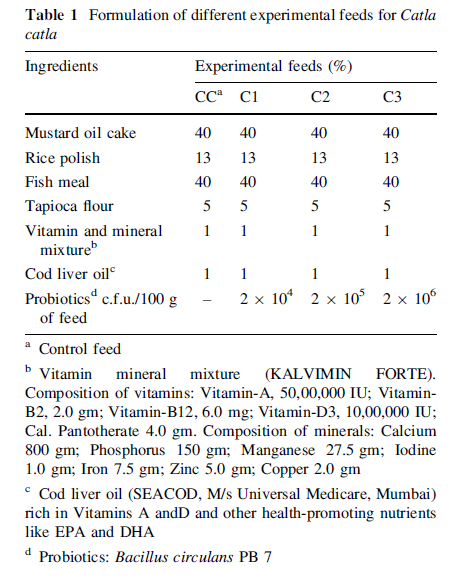

the four prepared feeds (CC, C1, C2, and C3) are detailed in Table 2. The probiotic bacterium Bacillus circulans PB 7 isolated from the intestine of Catla catla was grown in 48 h at 30 C in shaken bottles with nutrient agar medium (Hi-media, India). The cultures were centrifuged at 5,000g at 15 min in 4 C, washed thrice with sterile 1.0% NaCl solution, and the pellets resuspended in sterile saline water. The experimental diets were prepared by absorbing suspension of the probiotic bacteria. The prepared feeds were sterilized and spread in the sterile trays, and the absorption was achieved by spraying the suspended probiotic bacteria in 2 9 104 (C1), 2 9 105 (C2), and 2 9 106 (C3) B. circulans cells per 100 g feed. After spraying, the feed was air dried in a vent hood at room temperature overnight, and the moisture content and the bacterial concentration in the feeds (c.f.u. 100 g-1) was calculated. The bacterial concentration was calculated 1.86 9 104, 1.73 9 105, and 1.66 9 106 c.f.u. 100 g-1 of feed C1, C2, and C3, respectively. The control feed (CC) was not supplemented with the B. circulans. Finally, the feed was stored in vacuumed heavy-duty plastic containers at 4 C (Robertson et al. 2000). Routine checking of the bacterial concentration in the feeds did not show any marked variation. Studies on growth and dietary performances The experimental setup consisted of 15 rectangular aquarium (triplicates of each treatment) of 200 l
capacity with continuous aeration. Each aquarium was stoked with 15 fish. Water quality (temperature, pH, dissolved oxygen, total alkalinity, total NH3) was monitored at weekly intervals following the methods provided in APHA-AWWA-WPCF (1998). Fish were fed twice daily at 0800 and 1600 hours at 5% body weight (Swain et al. 1996) in two equal installments. The unutilized/leftover feeds orts were siphoned out 1 h after dispensing the feed into the aquarium. Fifty
percent of the water was replenished daily with aged water. The net weight was recorded every 15 days with an electronic balance (Adair Dutt Instruments, Kolkata, India) and feed quality was readjusted after every weighing period of 15 days. For evaluating the dietary performances, the nutritional indices like live weight gain (LWG), average daily growth (ADG), feed conversion ratio (FCR), specific growth rate (SGR), and protein efficiency ration (PER) were used. Two fish of each group were terminated through overdose anesthetization by MS222 (Sigma Chemicals, India) at the end of the experiment, and stored at -20 C until analysis. Proximate analysis Proximate analyses of ingredients, feeds, faecal matter, and body carcass were determined following the method provided in AOAC (1990). Moisture content was determined by drying the samples in hot air oven (M/s Modern Industrial) at 110 C for 24 h. Crude protein content (Total Kjeldahl Nitrogen 9 6.25) were
estimated by micro-Kjeldahl method. Crude lipid contents were determined by the soxhlet extraction
method using petroleum ether (boiling point: 40–60 C) in the electro-thermal Soxhlet apparatus. After extraction of lipid, the defattend samples were used for the estimation of crude fiber following Patra (2002). Ash content was estimated by incinerating samples in a muffle furnace at 500 ± 50 C for 10 h. One hour after feeding, the leftover feed was initially siphoned out and an equal amount of water replenished. For fecal matter analyses, pooled fecal matter was collected into Petri dishes from the bottom of the aquarium every 2 h by the help of a pipette (Singh 1989). The collected material was stored at -20 C (Sundaryono et al. 1996). The collected material was dried in an oven (M/s Modern Industrial) at 110 C for 24 h. Crude protein content (Total Kjeldahl Nitrogen 9 6.25) were
estimated by micro-Kjeldahl method. Crude lipid contents were determined by the soxhlet extraction
method using petroleum ether (boiling point: 40–60 C) in the electro-thermal Soxhlet apparatus. After extraction of lipid, the defattend samples were used for the estimation of crude fiber following Patra (2002). Ash content was estimated by incinerating samples in a muffle furnace at 500 ± 50 C for 10 h. One hour after feeding, the leftover feed was initially siphoned out and an equal amount of water replenished. For fecal matter analyses, pooled fecal matter was collected into Petri dishes from the bottom of the aquarium every 2 h by the help of a pipette (Singh 1989). The collected material was stored at -20 C (Sundaryono et al. 1996). The collected material was dried in an oven (M/s Modern Industrial) at 55 C, ground and preserved in airtight containers.
feeds was presented in Fig. 1. Significantly (P B 0.05) highest growth (20.15 ± 0.075 g) was obtained from fish fed feed C2, whereas lowest (16.95 ± 0.120 g) occurred in fish fed feed C3, which was even lower than the control (feed CC). Fish fed feed C2 showed significantly (P B 0.05) highest live weight gain (14.00 ± 0.086 g) followed by C1, CC, and C3 (Table 3). Significantly (P B 0.05) lowest FCR (2.26 ± 0.021) was obtained


from fish fed feed C2 while the highest (3.30 ± 0.042) was recorded in case of fish fed feed C3 (Table 3). It was also observed that significantly (P B 0.05) highest SGR of 1.98 ± 0.011 was obtained in the fish fed feed C2 showing better utilization of nutrients and the lowest (1.55 ± 0.014) in fish fed feed C3 showing lowest utilization of nutrients. Similarly, the highest (P B 0.05) PER of 1.22 ± 0.010 was obtained in fish fed feed C2, which indicated better utilization of protein for growth and metabolism (Table 3). Initial and final carcass composition of Catla catla in relation to various feeds was presented in Table 4. The carcass composition of the fish revealed an apparent increase in the final carcass protein and lipid (P B 0.05) over the initial carcass protein and lipid. Significantly (P B 0.05) highest carcass protein (65.48 ± 0.002%) and lipid (22.80 ± 0.004%) was recorded in fish fed feed C2, while the lowest was in the controls (CC). These results indicated that enhancement of carcass quality by probiotic-supplemented (Bacillus circulans PB 7) feeds may be due to enzymatic activity in the gut and thereby better nutrient utilization. Proximate composition of fecal matter of Catla catla during the 60-day feeding trial is presented in Table 5. Fecal matter proximate analysis revealed significantly (P B 0.05) greatest nitrogen excretion (14.86 ± 0.006%) in fish fed feed CC and least (11.52 ± 0.007%) in fish fed feed C2 (Table 5). The crude lipid remained between 02.19 ± 0.001% (feed C1) and 3.16 ± 0.002% (feed CC). The relationships of different water quality parameters did not follow any specific trend of controlled conditions and isocaloric feeds. The water quality during the study, period remained in the following


ranges: pH, 7.47 ± 0.182–7.52 ± 0.164; total alkalinity 130.80 ± 4.980–140.25 ± 9.680; DO, 4.40 ±
0.595–5.63 ± 0.420; total ammonia, 0.270 ± 0.031– 0.390 ± 0.028, and average temperature was
30.00 ± 1.155. Significantly (P B 0.05) greater RNA:DNA ratio (1.95 ± 0.011) was registered in fish fed feed C2 and least (1.66 ± 0.010) in fish fed feed CC (Fig. 2). It was also observed that the RNA:DNA ratio of fish increased in all the treatments over the initial RNA:DNA ratio. Significantly (P B 0.05) highest protease was recorded in fish fed feed C2 (47.9 ± 0.016) and lowest in fish fed feed C3 (32.10 ± 0.009) (Table 6), whereas there were no significant differences (P B 0.05) in a amylase activity (Table 7). The ACP activity in the liver was greatest (P B 0.05) in case of fish fed feed C2 (3.78 ± 0.027) and least (2.06 ± 0.032) in case of fish fed feed CC (Table 8). Similarly, ALP activity in the liver was shown a similar trend (Table 8).

Significantly (P B 0.05) highest GOT (0.052 ± 0.000) and GPT (0.083 ± 0.002) values were registered in fish fed feed C2, whereas lowest (0.045 ± 0.000) GOT value was recorded in fish fed feed CC and GPT value (0.044 ± 0.005) in fish fed feed C3 (Table 8).


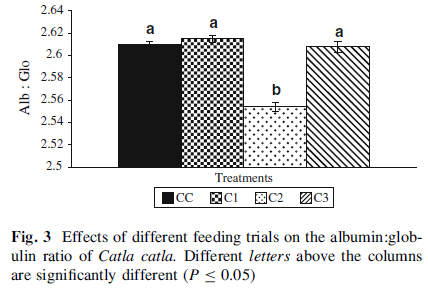
The effect of different feed treatments on the albumin:globulin ratio is presented in Fig. 3. Highest
albumin:globulin ratio was recorded in fish fed feed CC and lowest in fish fed feed C2. The albumin:globulin ratio showed a similar trend after challenge trial, but the values were slightly lower than the feeding trial, perhaps because of decrease in TSP values. The effect of probiotics (Bacillus circulans PB 7) on non-specific immunity was observed. Significantly (P B 0.05) highest phagocytic ratio (63.00 ± 1.22), phagocytic index (2.34 ± 0.09), and leucocrit value (62.20 ± 1.80) were recorded in fish fed feed C2, whereas the lowest of all the values (8.00 ± .086, 1.49 ± 0.20, and 34.10 ± 3.86, respectively, were recorded in fish fed feed C3 (Figs. 4, 5, and 6, respectively). After a 10-day challenge trial, significantly (P B 0.05) highest survivability (96.66%) was


observed in fish fed feed C2, followed by fish fed C1 (53.33%), C3 (40%), and CC (6.66%) (Fig. 7).
Regression results of different parameters with respect to different probiotic supplements in Catla
catla are presented in Table 9.
Aerobic gram-positive endospore-forming bacteria, i.e., Bacillus sp., have been evaluated as probiotics, with uses including the improvement of water quality
by influencing the composition of water-born microbial populations and by reducing the number of
pathogens in the vicinity of the farmed species (Wang et al. 1999). Thus, the bacilli are thought to
antagonize potential pathogens in the aquatic environments. This is curious because it is generally
accepted that laboratory cultures do not survive well when re-introduced into the natural environment, the cells being often outcompeted/antagonized by the natural microflora (Austin et al. 1995). Nevertheless, direct benefits from the use of the bacilli were a reduction in the use of chemicals in the aquatic environment and enhanced growth of farmed species (Wang et al. 1999).
The use of probiotics has been accompanied by a concomitant reduction in the levels of antimicrobial
compounds (particularly antibiotics) used in aquaculture, and improved appetite and/or growth
performance of the farmed species. The former is obvious insofar as if the animals are otherwise
healthy then there will no need to use antimicrobial compounds. However, the inference about improved appetite and growth is more difficult to reconcile. In particular, it is important to determine whether or not probiotic actually tastes good or does it modify the feed thereby improving digestibility (and taste). Apart from laboratory preparations of bacteria, some workers have used commercially available products. For example, Queiroz and Boyd (1998)


and Moriarty (1998) used commercial preparations containing Bacillus sp. in catfish and shrimp ponds, respectively. Hirata et al. (1998) used mixed cultures consisting mainly of Bacillus sp. to improve the performance of the rotifer, Branchionus plicatilis, in water. Furthermore, Kennedy et al. (1998) used Bacillus 48 to enhance the quality and viability of common snook, Centropomus undecimalis (Bloch). These workers found that Bacillus improved the survival of larvae, increased food absorption by enhancing protease levels, and gave better growth. Also, the probiotic decreased the number of suspected pathogenic bacteria in the gut. It is noteworthy that Chang and Liu (2002) used Bacillus toyoi and Enterococcus faecium SF 68 from commercial products to reduce Edwardsiellosis in the European eel, Anguilla anguilla (L.). An extracellular proteaseproducing bacteria, Bacillus circulans (Lr 1.1), was isolated by Ghosh et al. (2003) from the gut of Labeo rohita fingerlings and used as supplement in the diets
and the effect of supplement on growth performance and utilization efficiency of L. rohita was measured. The diet containing 1.5 9 105 Bacillus circulans cells per 100 g showed significantly better growth, lower feed conversion ratio, higher protein efficiency ratio, and highest protease activity. Similar observations were also recorded in the present study, where 2 9 105 Bacillus circulans PB 7 cells per 100 g showed significantly better growth, lower feed conversion ratio, higher protein efficiency ratio, and highest protease activity. In this study, although all the feeds were isonitrogenous, the concentration of probiotics in the C2 feed might be helpful for proper nutrient utilization. The whole body carcass composition and lower nitrogen egestion which were observed in fish fed feed C2 is attributable to proper probiotic concentration, whereas reduced carcass composition and greater nitrogen egestion were observed in fish fed feed C3, which could have also been due to the overall low feed utilization level. RNA:DNA is known to provide a dependable indication of growth trend (Buckley 1980; Khan and Jafri 1991; Bandyopadhyay et al. 2005). The ratio was the greatest in the fish fed C2 feed with higher dietary utilization and best growth. Bazaz and Keshavanath (1993) found a higher RNA:DNA ratio in better growing fish fed with oil-supplemented diets using equal level of crude protein. The present study also reports such a finding where all the feeds were isocaloric and isonitrogenous, but 2 9 105 Bacillus circulans PB 7 cells per 100 g incorporated feed (feed C2) exhibited better growth as well as better RNA:DNA ratio. The highest levels of GOT and GPT were found with the feed C2 and the lowest in the control (feed CC),
which may be because of the better dietary protein utilization. Most of the amino acids normally found in protein undergo transamination reactions, and transaminases are localized in both cytosol and mitochondria (Wada and Marino 1964), which is induced by high protein diet (Swick et al. 1965). Thus, a positive correlation between the probiotic concentration and the GOT and GPT levels in the liver could be observed. The ALP and ACP activities of the liver also showed an excellent trend and were dependent upon the probiotic concentration in the feed. It was observed that the probiotic-containing feed C2 showed higher ALP and ACP activity as well as higher dietary utilization and growth, which was similar to the observation of Bandyopadhyay et al.
(2005). In this present study, a superior growth performance in terms of live weight gain and specific
growth rate was noted in C. catla fed feed C2 when compared to other treatments. This observation draws attention to an essential inference that the probiotic concentration, which was used in this feed, might be helpful for optimum dietary utilization. It was also observed that P/E ratio was highest in fish fed feed C2 although with the highest dietary utilization. Mohanty et al. (1996) reported that the higher the dietary utilization the higher the P/E ratio, which was contradicted in fish fed feed C2 in this study. This may be because of the supply of higher energy from the higher carcass lipid content in fish fed feed C2. The results obtained in this study not only support the use of probiotic (Bacillus circulans PB 7) for better growth and proper nutrient utilization but also confirm it to be an important immunostimulant in Catla catla. There was a statistically significant (P B 0.05) increase in all the parameters of non-specific immunity examined, as well as a higher survival against the pathogenic Aeromonas hydrophila infection, thus indicating it as a potent immunostimulant in Catla catla. Highest PR, PI, and leucocrit value (P B 0.05) and lowest albumin: globulin ratio (P B 0.05) were observed in fish fed feed C2 might be due to increased lymphocyte proliferation and subsequent immunoglobulin production. A similar observation was made by Sahoo and Mukherjee (2001) by using b-1,3, glucan as an immunostimulant. The findings of this study suggest that the concentration of probiotic Bacillus circulans PB 7 applied in feed C2 was able to increase the overall physiological performances and enhance the defense mechanism in the fingerlings of Catla catla. Further investigation should be applied by preparing the feeds with different concentrations of this probiotic bacterium between the two best feeds achieved in this study. The findings should also be confirmed in outdoor, earthen pond, trials before commercialization.
estimated by micro-Kjeldahl method. Crude lipid contents were determined by the soxhlet extraction
method using petroleum ether (boiling point: 40–60 C) in the electro-thermal Soxhlet apparatus. After extraction of lipid, the defattend samples were used for the estimation of crude fiber following Patra (2002). Ash content was estimated by incinerating samples in a muffle furnace at 500 ± 50 C for 10 h. One hour after feeding, the leftover feed was initially siphoned out and an equal amount of water replenished. For fecal matter analyses, pooled fecal matter was collected into Petri dishes from the bottom of the aquarium every 2 h by the help of a pipette (Singh 1989). The collected material was stored at -20 C (Sundaryono et al. 1996). The collected material was dried in an oven (M/s Modern Industrial) at 55 C, ground and preserved in airtight containers.
Biochemical analyses
DNA (deoxy-ribo nucleic acid) and RNA (ribonucleic acid) contents in 200 mg of liver (hepatopancreas) tissues were estimated as per the scheme given by Munro and Fleck (1969). The activity of the two digestive enzymes, protease and a-amylase, in the intestine of the fish were determined according to the method of Bernfeld (1955) as modified by Snell and Snell (1971). The GOT and GPT activity in the liver were determined following the method of Bernfeld (1955), while ACP activity was determined the method of Bramley (1974) and ALP activity by Rosauki (1993).Determination of immunity levels
On day 60, blood was collected from fish of each group. Part of the blood was heparinized and the rest was allowed to clot for serum samples, which were preserved at -20 C for further analysis. Immediately after collection, the heparinized blood samples of each group were pooled to three aliquots. Part of the blood was analyzed for leucocrit value in duplicate per sample (Blaxhall and Daisley 1973). The rest of the heparinized blood was immediately used for the phagocytic assay (Siwicki et al. 1994; Park and Jeong 1996).Challenge trial
After feeding for 60 days, the fish in each treatment were challenged with Aeromonas hydrophila AH1, which had been cultured and maintained in the Aeromonas selective medium (M884, Hi-Media). Fish in all replicates were immersed in a suspension of Aeromonas hydrophila AH1, *105 c.f.u. ml-1 according to Austin et al. (1995). This was followed by a second immersion *107 c.f.u. ml-1 after 7 days (Austin et al. 1995).Statistical analysis
As all the above analyses were carried out on pooled samples of a given lot, standard errors or standard deviation of means were calculated. However, for evaluating the dietary performances, nutritional indices, enzymatic activities, and RNA:DNA ratio, immunological parameters, and challenge trials, significant differences between the means of the treatments were tested by Duncan Multiple Range Test (Duncan 1955) through SAS (1991).Results
All the four experimental feeds (CC, C1, C2, and C3 in Table 1) were almost isocaloric and isonitrogenous. The average crude protein percentage on dry matter basis was around 36.92 and the gross energy was around 17.08 kJ g-1 (Table 2). The growth of Catla catla in relation to variousfeeds was presented in Fig. 1. Significantly (P B 0.05) highest growth (20.15 ± 0.075 g) was obtained from fish fed feed C2, whereas lowest (16.95 ± 0.120 g) occurred in fish fed feed C3, which was even lower than the control (feed CC). Fish fed feed C2 showed significantly (P B 0.05) highest live weight gain (14.00 ± 0.086 g) followed by C1, CC, and C3 (Table 3). Significantly (P B 0.05) lowest FCR (2.26 ± 0.021) was obtained


from fish fed feed C2 while the highest (3.30 ± 0.042) was recorded in case of fish fed feed C3 (Table 3). It was also observed that significantly (P B 0.05) highest SGR of 1.98 ± 0.011 was obtained in the fish fed feed C2 showing better utilization of nutrients and the lowest (1.55 ± 0.014) in fish fed feed C3 showing lowest utilization of nutrients. Similarly, the highest (P B 0.05) PER of 1.22 ± 0.010 was obtained in fish fed feed C2, which indicated better utilization of protein for growth and metabolism (Table 3). Initial and final carcass composition of Catla catla in relation to various feeds was presented in Table 4. The carcass composition of the fish revealed an apparent increase in the final carcass protein and lipid (P B 0.05) over the initial carcass protein and lipid. Significantly (P B 0.05) highest carcass protein (65.48 ± 0.002%) and lipid (22.80 ± 0.004%) was recorded in fish fed feed C2, while the lowest was in the controls (CC). These results indicated that enhancement of carcass quality by probiotic-supplemented (Bacillus circulans PB 7) feeds may be due to enzymatic activity in the gut and thereby better nutrient utilization. Proximate composition of fecal matter of Catla catla during the 60-day feeding trial is presented in Table 5. Fecal matter proximate analysis revealed significantly (P B 0.05) greatest nitrogen excretion (14.86 ± 0.006%) in fish fed feed CC and least (11.52 ± 0.007%) in fish fed feed C2 (Table 5). The crude lipid remained between 02.19 ± 0.001% (feed C1) and 3.16 ± 0.002% (feed CC). The relationships of different water quality parameters did not follow any specific trend of controlled conditions and isocaloric feeds. The water quality during the study, period remained in the following


ranges: pH, 7.47 ± 0.182–7.52 ± 0.164; total alkalinity 130.80 ± 4.980–140.25 ± 9.680; DO, 4.40 ±
0.595–5.63 ± 0.420; total ammonia, 0.270 ± 0.031– 0.390 ± 0.028, and average temperature was
30.00 ± 1.155. Significantly (P B 0.05) greater RNA:DNA ratio (1.95 ± 0.011) was registered in fish fed feed C2 and least (1.66 ± 0.010) in fish fed feed CC (Fig. 2). It was also observed that the RNA:DNA ratio of fish increased in all the treatments over the initial RNA:DNA ratio. Significantly (P B 0.05) highest protease was recorded in fish fed feed C2 (47.9 ± 0.016) and lowest in fish fed feed C3 (32.10 ± 0.009) (Table 6), whereas there were no significant differences (P B 0.05) in a amylase activity (Table 7). The ACP activity in the liver was greatest (P B 0.05) in case of fish fed feed C2 (3.78 ± 0.027) and least (2.06 ± 0.032) in case of fish fed feed CC (Table 8). Similarly, ALP activity in the liver was shown a similar trend (Table 8).

Significantly (P B 0.05) highest GOT (0.052 ± 0.000) and GPT (0.083 ± 0.002) values were registered in fish fed feed C2, whereas lowest (0.045 ± 0.000) GOT value was recorded in fish fed feed CC and GPT value (0.044 ± 0.005) in fish fed feed C3 (Table 8).


The effect of different feed treatments on the albumin:globulin ratio is presented in Fig. 3. Highest
albumin:globulin ratio was recorded in fish fed feed CC and lowest in fish fed feed C2. The albumin:globulin ratio showed a similar trend after challenge trial, but the values were slightly lower than the feeding trial, perhaps because of decrease in TSP values. The effect of probiotics (Bacillus circulans PB 7) on non-specific immunity was observed. Significantly (P B 0.05) highest phagocytic ratio (63.00 ± 1.22), phagocytic index (2.34 ± 0.09), and leucocrit value (62.20 ± 1.80) were recorded in fish fed feed C2, whereas the lowest of all the values (8.00 ± .086, 1.49 ± 0.20, and 34.10 ± 3.86, respectively, were recorded in fish fed feed C3 (Figs. 4, 5, and 6, respectively). After a 10-day challenge trial, significantly (P B 0.05) highest survivability (96.66%) was


observed in fish fed feed C2, followed by fish fed C1 (53.33%), C3 (40%), and CC (6.66%) (Fig. 7).
Regression results of different parameters with respect to different probiotic supplements in Catla
catla are presented in Table 9.
Discussion
Aerobic gram-positive endospore-forming bacteria, i.e., Bacillus sp., have been evaluated as probiotics, with uses including the improvement of water quality
by influencing the composition of water-born microbial populations and by reducing the number of
pathogens in the vicinity of the farmed species (Wang et al. 1999). Thus, the bacilli are thought to
antagonize potential pathogens in the aquatic environments. This is curious because it is generally
accepted that laboratory cultures do not survive well when re-introduced into the natural environment, the cells being often outcompeted/antagonized by the natural microflora (Austin et al. 1995). Nevertheless, direct benefits from the use of the bacilli were a reduction in the use of chemicals in the aquatic environment and enhanced growth of farmed species (Wang et al. 1999).
The use of probiotics has been accompanied by a concomitant reduction in the levels of antimicrobial
compounds (particularly antibiotics) used in aquaculture, and improved appetite and/or growth
performance of the farmed species. The former is obvious insofar as if the animals are otherwise
healthy then there will no need to use antimicrobial compounds. However, the inference about improved appetite and growth is more difficult to reconcile. In particular, it is important to determine whether or not probiotic actually tastes good or does it modify the feed thereby improving digestibility (and taste). Apart from laboratory preparations of bacteria, some workers have used commercially available products. For example, Queiroz and Boyd (1998)


and Moriarty (1998) used commercial preparations containing Bacillus sp. in catfish and shrimp ponds, respectively. Hirata et al. (1998) used mixed cultures consisting mainly of Bacillus sp. to improve the performance of the rotifer, Branchionus plicatilis, in water. Furthermore, Kennedy et al. (1998) used Bacillus 48 to enhance the quality and viability of common snook, Centropomus undecimalis (Bloch). These workers found that Bacillus improved the survival of larvae, increased food absorption by enhancing protease levels, and gave better growth. Also, the probiotic decreased the number of suspected pathogenic bacteria in the gut. It is noteworthy that Chang and Liu (2002) used Bacillus toyoi and Enterococcus faecium SF 68 from commercial products to reduce Edwardsiellosis in the European eel, Anguilla anguilla (L.). An extracellular proteaseproducing bacteria, Bacillus circulans (Lr 1.1), was isolated by Ghosh et al. (2003) from the gut of Labeo rohita fingerlings and used as supplement in the diets
and the effect of supplement on growth performance and utilization efficiency of L. rohita was measured. The diet containing 1.5 9 105 Bacillus circulans cells per 100 g showed significantly better growth, lower feed conversion ratio, higher protein efficiency ratio, and highest protease activity. Similar observations were also recorded in the present study, where 2 9 105 Bacillus circulans PB 7 cells per 100 g showed significantly better growth, lower feed conversion ratio, higher protein efficiency ratio, and highest protease activity. In this study, although all the feeds were isonitrogenous, the concentration of probiotics in the C2 feed might be helpful for proper nutrient utilization. The whole body carcass composition and lower nitrogen egestion which were observed in fish fed feed C2 is attributable to proper probiotic concentration, whereas reduced carcass composition and greater nitrogen egestion were observed in fish fed feed C3, which could have also been due to the overall low feed utilization level. RNA:DNA is known to provide a dependable indication of growth trend (Buckley 1980; Khan and Jafri 1991; Bandyopadhyay et al. 2005). The ratio was the greatest in the fish fed C2 feed with higher dietary utilization and best growth. Bazaz and Keshavanath (1993) found a higher RNA:DNA ratio in better growing fish fed with oil-supplemented diets using equal level of crude protein. The present study also reports such a finding where all the feeds were isocaloric and isonitrogenous, but 2 9 105 Bacillus circulans PB 7 cells per 100 g incorporated feed (feed C2) exhibited better growth as well as better RNA:DNA ratio. The highest levels of GOT and GPT were found with the feed C2 and the lowest in the control (feed CC),
which may be because of the better dietary protein utilization. Most of the amino acids normally found in protein undergo transamination reactions, and transaminases are localized in both cytosol and mitochondria (Wada and Marino 1964), which is induced by high protein diet (Swick et al. 1965). Thus, a positive correlation between the probiotic concentration and the GOT and GPT levels in the liver could be observed. The ALP and ACP activities of the liver also showed an excellent trend and were dependent upon the probiotic concentration in the feed. It was observed that the probiotic-containing feed C2 showed higher ALP and ACP activity as well as higher dietary utilization and growth, which was similar to the observation of Bandyopadhyay et al.
(2005). In this present study, a superior growth performance in terms of live weight gain and specific
growth rate was noted in C. catla fed feed C2 when compared to other treatments. This observation draws attention to an essential inference that the probiotic concentration, which was used in this feed, might be helpful for optimum dietary utilization. It was also observed that P/E ratio was highest in fish fed feed C2 although with the highest dietary utilization. Mohanty et al. (1996) reported that the higher the dietary utilization the higher the P/E ratio, which was contradicted in fish fed feed C2 in this study. This may be because of the supply of higher energy from the higher carcass lipid content in fish fed feed C2. The results obtained in this study not only support the use of probiotic (Bacillus circulans PB 7) for better growth and proper nutrient utilization but also confirm it to be an important immunostimulant in Catla catla. There was a statistically significant (P B 0.05) increase in all the parameters of non-specific immunity examined, as well as a higher survival against the pathogenic Aeromonas hydrophila infection, thus indicating it as a potent immunostimulant in Catla catla. Highest PR, PI, and leucocrit value (P B 0.05) and lowest albumin: globulin ratio (P B 0.05) were observed in fish fed feed C2 might be due to increased lymphocyte proliferation and subsequent immunoglobulin production. A similar observation was made by Sahoo and Mukherjee (2001) by using b-1,3, glucan as an immunostimulant. The findings of this study suggest that the concentration of probiotic Bacillus circulans PB 7 applied in feed C2 was able to increase the overall physiological performances and enhance the defense mechanism in the fingerlings of Catla catla. Further investigation should be applied by preparing the feeds with different concentrations of this probiotic bacterium between the two best feeds achieved in this study. The findings should also be confirmed in outdoor, earthen pond, trials before commercialization.


